Miami Flooring: A Material Guide for the Local Climate
Choosing Miami flooring? How humidity, salt air, condo concrete slabs, and large-format porcelain shape the material decision across Miami-Dade and Broward.
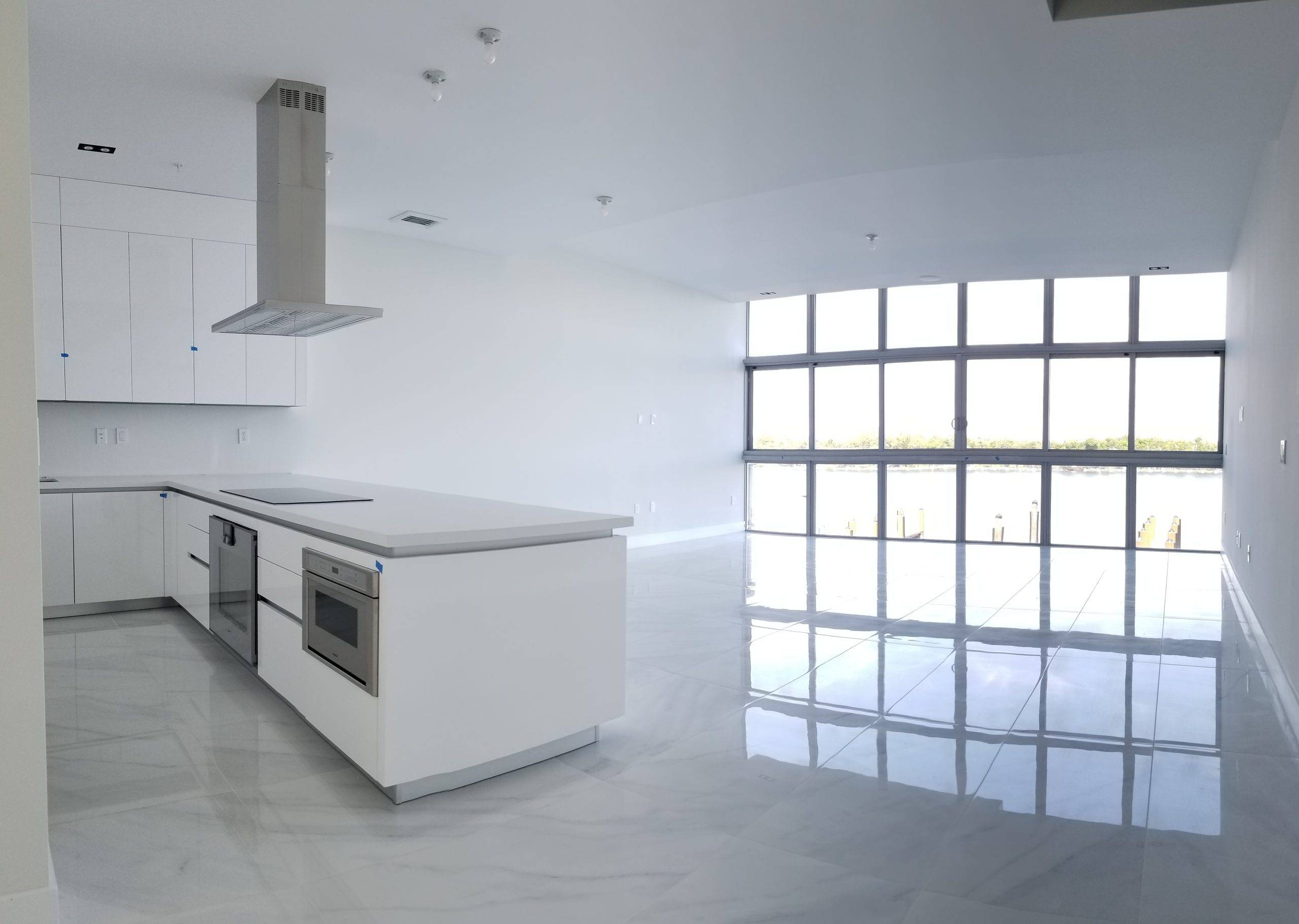
Miami flooring is decided more by the climate and the slab than by the finish on the showroom sample. A 75% RH concrete deck on the 32nd floor of a Brickell tower behaves nothing like a ground-floor slab in Coral Gables, and a pool deck two blocks from the bay has to carry salt air, UV, and a wet-bare-foot slip rating that an interior floor will never see. The right material is the one engineered for the room it lives in.
This guide is written for homeowners and designers comparing flooring options for a Miami home, condo, or terrace. We work in Miami-Dade and Broward — Brickell, Coral Gables, Key Biscayne, Miami Beach, Pinecrest — and the choices below reflect what we actually set every day, not a generic catalog.
What Miami flooring really has to handle
Miami flooring sits between four hard constraints: high ambient humidity (often 70–85% indoors without air handling), concrete substrates that release moisture for years after pour, salt air on coastal properties, and condo association rules that govern sound transmission, load, and material approval. Every flooring decision in Miami is a response to one or more of those four.
That is the part most “best flooring options” articles miss. The finish is the easy decision. The substrate, the moisture profile, the membrane, and the joint detail are where the project succeeds or quietly fails.
The flooring materials that work in a Miami home
The shortlist is narrower than it looks. Anything that swells, cups, sweats, or stains in 80% humidity is filtered out before we walk the showroom.
Large-format porcelain slab
The default for premium Miami residences. Porcelain at 6, 12, or 20 mm is fired to roughly Mohs 8–9, near-zero porosity, and dimensionally stable across the humidity swings a Miami home will see in a normal year. Large-format panels — Laminam at 1620 × 3240 mm, Neolith at 1500 × 3200 mm, Dekton at 1440 × 3200 mm — read as a continuous plane with a 1.5 mm joint, which is why architects spec them for great rooms, kitchen islands, and bath floors where any visible grout joint would break the line.
The trade-off is the install. A 1620 × 3240 mm slab telegraphs substrate flatness in a way 12-inch tile never does. The substrate has to be flat to ± 1.5 mm over a 3 m straightedge — the manufacturer-published threshold below which the slab sets without a hollow. We pour self-leveling underlayment and laser-scan the room before the first slab leaves the crate.
For the deeper spec — handling, mortar, RLS leveling, epoxy grout — see large-format porcelain slab installation, and for the full editorial guide on choosing between Laminam, Neolith, and Dekton, read our pillar on large-format porcelain installation in Miami.
Natural stone — marble, travertine, limestone
Stone still has a place in Miami homes, especially Calacatta, Statuario, and Nero Marquina marble in baths and entries, and honed travertine on shaded terraces. Stone reads warmer than porcelain and ages with patina that porcelain cannot reproduce.
The Miami caveats are real. Marble is reactive — orange juice, lemon, and many cleaners will etch a polished surface in seconds. Light limestone yellows under UV on exterior applications. Travertine is porous and needs sealing on a schedule. We honed-finish most marble floors, seal annually, and route stone toward dry interiors and shaded exteriors rather than full-sun pool decks.
Stone and marble installation walks through the substrate, mortar, and sealing schedule we use for Calacatta floors and Nero Marquina baths in Coral Gables and Miami Beach. The pillar guide on marble installation in Miami extends that with the Miami-specific sealer reapplication schedule by microclimate.
Engineered wood, with caveats
Solid hardwood is rarely the right call in Miami. The board cups, gaps, and crowns under humidity swings, and most condo associations restrict it on upper floors for sound. Engineered wood with a stable plywood core is workable in single-family interiors that hold steady humidity, but it still requires moisture-tested substrates, vapor reduction, and a sealed perimeter.
If a designer wants the warmth of wood in a Miami project, we more often recommend a wood-look porcelain plank — 24 × 48 inch or 12 × 48 inch large-format porcelain with a printed wood grain — bonded over a leveled substrate. It carries the look without the cupping.
Outdoor porcelain for terraces and pool decks
Coastal Miami flooring outside the building line is its own category. The deck has to be UV-stable, freeze-thaw irrelevant in our climate but salt-stable mandatory, R11 / DCOF ≥ 0.42 slip-rated for wet-bare-foot traffic, and built on a system rated for Miami-Dade NOA wind-load on raised terraces.
We set Dekton, Neolith, and Laminam outdoor lines on Mapei Mapelastic waterproofing, with marine-grade 316 stainless drains and pedestal systems where the terrace sits over occupied space. Lighter colors run 8–12 °F cooler than dark formats in midday Miami sun — a real factor on a barefoot pool deck.
The full spec sheet for pool deck and outdoor porcelain covers the wind-load reports, the slip rating, and the anchor schedule we hand to the engineer of record.
The substrate is where most Miami flooring projects fail
Almost every Miami flooring failure traces back to the substrate, not the surface. The three failure modes we see, in order:
-
Moisture coming up through the slab. Concrete in Miami often releases moisture for years after pour. We RH-test the slab to ASTM F2170, and on anything above 75% relative humidity we install LATICRETE NXT Vapor Reduction before any setting material goes down. Skipping this is how you get bubbled wood, lifted vinyl, and porcelain bonds that release at the perimeter.
-
Out-of-plane slab. Large-format porcelain demands ± 1.5 mm over 3 m. Most builder-grade Miami slabs are out by 6–12 mm before correction. Skim patches do not fix this — a poured self-leveling underlayment keyed into a primed substrate does.
-
Movement and uncoupling. Concrete moves, especially on long runs and at thermal transitions to exterior glass. Schluter Ditra-XL and Schluter Ditra-Heat uncouple the finished surface from substrate movement and let the floor breathe. We specify them on every plywood-over-joist condition and on most ground-floor pours over 1,000 sq ft.
Floor leveling and substrate prep is the service most homeowners do not realize they are paying for until they meet a contractor who skips it. For the field-level walk-through — the 90-minute mapping method, RH testing, and SLU pour sequence on a Brickell condo deck — see our floor leveling in Miami guide.
Condo flooring rules: what your association will require
Most Brickell, Key Biscayne, Sunny Isles, and Miami Beach high-rise associations require:
- A sound rating — typically IIC 50 or higher for Impact Insulation Class — on any new hard-surface flooring above ground level. We meet the spec with Schluter Ditra-Heat-DUO or QuietWalk Plus under porcelain.
- A building engineer letter confirming the new floor system weight is within slab loading, especially for stone and 20 mm porcelain.
- A service-elevator hold time for slab delivery — a 3,240 mm Laminam panel does not turn the corner of a 5 ft passenger elevator.
- A construction window matched to association rules — typically Mon–Fri 8a–5p, no weekend setting, no jackhammering after 10a.
- An insurance certificate naming the association as additional insured.
We coordinate the engineering letter, the elevator schedule, and the COI before delivery, and we pull permits where the scope requires it. The Miami Floors is Schluter certified; the license number is what most associations check first.
Spec comparison: how Miami flooring options compare
| Material | Indoor / outdoor | Joint width | Maintenance | Best Miami use |
|---|---|---|---|---|
| Large-format porcelain slab (Laminam, Neolith, Dekton) | Both | 1.5 mm dry joint | Damp cloth; no sealing | Great rooms, kitchens, baths, pool decks |
| Wood-look porcelain plank | Indoor + covered exterior | 2–3 mm | Damp cloth; no sealing | Bedrooms, hallways, family rooms |
| Calacatta / Statuario marble | Indoor (honed preferred) | 2 mm | Annual seal; pH-neutral cleaner | Primary baths, entry foyers, fireplace surrounds |
| Travertine, limestone | Indoor + shaded terraces | 3–6 mm | Seal every 1–2 years | Covered loggias, courtyards, mudrooms |
| Engineered wood | Indoor only, stable RH | Plank-tight | Microfiber; humidifier control | Single-family interiors with HVAC discipline |
| Outdoor porcelain (UV, R11) | Outdoor | 3–5 mm | Pressure rinse; no sealing | Pool decks, terraces, summer kitchens |
The right material for any one room is the row that survives the conditions in that specific room — humidity, sun, traffic, salt exposure, and association rules.
Common mistakes in Miami flooring projects
Three patterns we see when we walk a project mid-failure:
- Setting tile on an unleveled slab. The visible result is lippage at the joint and hollows under foot — both worse on large-format. The fix is rarely repair; the floor usually has to come up.
- Skipping moisture testing. A homeowner pays for premium engineered wood, and three months later the boards cup because the slab was 82% RH. The wood is replaced, the warranty is voided, and the substrate still has not been treated.
- Wrong material for the room. Polished marble in a kitchen with a citrus-loving family. Solid hardwood in a beachfront condo. Dark porcelain on a south-facing pool deck that hits 140 °F in July. The material did not fail; the spec did.
A serious bid will name the substrate test, the moisture treatment, the setting material, the joint width, and the maintenance schedule. If those line items are missing, the price is incomplete.
When The Miami Floors is the right fit
We are a fit for homeowners, architects, and interior designers who care about the substrate, the joint, and the moisture path as much as the finished surface. Our work concentrates in Miami-Dade and Broward, including Brickell, Coral Gables, Key Biscayne, Miami Beach, and Pinecrest, and runs from large-format porcelain slab in great rooms to honed marble baths to UV-stable porcelain pool decks.
The firm is led by Ivan Herrera, who personally walks every project before sign-off. The Miami Floors is Schluter certified, and built on more than 20 years of residential flooring, slab, bath, and veneer work — Laminam, Neolith, Dekton, LATICRETE, Sika, and Schluter as our standing partner systems.
If you are comparing Miami flooring options for a new build, a renovation, or a condo refresh, start with the substrate and the climate. The finished material is only as good as the system underneath it. For a related read on choosing the crew, see how to vet tile installers in Miami — and for bath-specific work, what to verify in a bathroom tile installer.
About the author
Ivan HerreraFounder, The Miami Floors
Ivan Herrera leads The Miami Floors and personally walks each project before sign-off. His work centers on large-format porcelain, waterproof shower systems, stone, and exterior porcelain surfaces across Miami-Dade and Broward.
Related Posts
3posts
Calacatta vs Nero Marquina: Choosing Marble for a Miami Bath
Ivan Herrera · April 29, 2026
Honed vs Polished Marble Floors: A Miami Safety Spec
Ivan Herrera · April 29, 2026